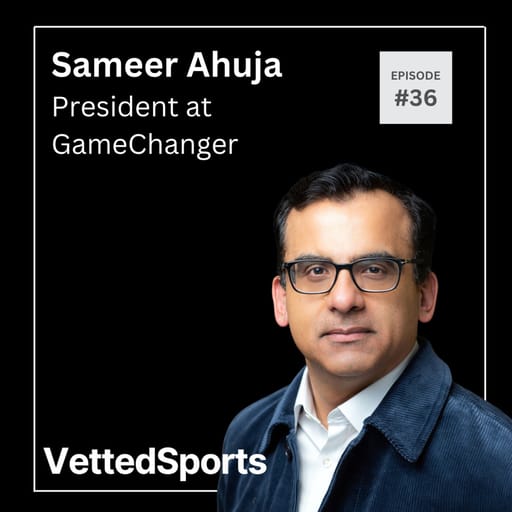
Transcript 0:00 [on hold music] So Amir, first off, I wanna thank you, um, for taking the time today to join the podcast. 0:17 Super excited to learn more about GameChanger and talk all things youth sports. 0:22 Um, but to start, you know, you've obviously kinda taken Cha- GameChanger through a pretty significant transformation over the past several years. 0:29 Can you talk about, you know, the, the company's purpose, not just the product, and kinda explain the platform and what you guys do for the youth sports ecosystem? Sure. Well, thank you for having me on. 0:41 Thank you for everything you're doing, and I appreciate the kind words. Uh, I like to describe GameChanger as a happiness company. 0:47 We deliver happiness to families all over the country who, uh, are connected with their kids through youth sports. We do that by capturing content of the game, and a lot of games. 1:00 We capture content of over eight million games. Every month on GameChanger, more games are covered than have been played in the entire history of all American professional sports combined ever. So the scale is dramatic. 1:12 In every community in every state in the country, we give you a tool, an app on your phone or your tablet to capture the game, stats, video. We add a lot of magical things to that content. We do AI recaps. 1:25 We, we, we aggregate stats. We do highlight clips, and that's the stuff people wanna see and share. They wanna text their families, "Look at what my kid did." 1:34 Grandma on the other side of the country can watch and consume this information. So it's really about taking the content and delivering it to the people who matter. 1:43 Unlike or different from pro sports, where there's a small number of teams with millions of fans, there's millions of youth sports teams, but the fans are the families, and it's really your kid, your grandkid that you're following. 1:55 So we figured out a model to connect those people, and, um, we have a lot of games covered in baseball and softball, basketball now, and we're excited to keep doing that in every other sport. 2:08 You know, we're constantly hearing, uh, the growth of the youth sports economy and, and how massive it is, but, you know, at-- in the same token, we're also hearing how fragmented it is, and you just mentioned- Yeah... 2:18 there's, you know- No... millions of teams out there. So what do you, what do you see as the biggest inefficiency or blind spot across the youth sports landscape? 2:29 I hear from parents directly the following type of statement all the time, "Why do I have to use," fill in the blank, "five apps, seven apps, ni-" I've heard one person say 11 apps. Hardcore youth sports family. 2:41 We love them, but that's super frustrating. 2:46 I don't know if people use five or 10 apps for anything else that they do, and maybe, you know, you have a few social media apps, but, you know, let's say you're doing, uh, meditation or something. 2:54 You know, it's like you might use one app, right? Um, you might have to use an app for your kid who plays football, different kid who plays basketball, one app for video streaming, another app for registering the kid. 3:08 There's a desire for a unified experience, not for the sake of saying you have a unified experience, but to make parents' lives easier, and that should be 3:19 available on your mobile device 'cause everyone in the world has one of these or more than one and using them all the time, and people are using mobile devices for really important things. And 3:30 ex-an experience that allows you to register your kid, find and acquire, you know, purchase whatever equipment they need, get them signed up for the right games, leagues, and tournaments, 3:41 get them to the game in terms of knowing all the logistics, being part of the team community, messaging and RSVPs, watching the content like we talked about, and then doing everything you need. 3:51 You know, maybe you want them to get a coaching session. Maybe you want them to explore other teams. Maybe they're an elite athlete and they're thinking about recruiting. 3:59 All in one place, 'cause the family is the center. The family's driving all of this, despite so many other people being involved. That, that's what fragmentation means to me. You're right. 4:09 As you said, it's, it's pretty dramatic right now. Uh, there's been talk of this for years. It hasn't 4:17 significantly changed, but, but it's, it's going to, and I think technology and AI and all that will accelerate it because we'll be able to build tools that work really well together. 4:25 How do, how do you guys think about the emotional component? 4:28 'Cause a lot of what you mentioned, um, you know, being as how important youth sports are to families, and this is very, very, you know, uh, emotionally driven, emotional ties, memories. 4:39 How do you guys think about that when you're designing capabilities, features, and e-expanding the product? 4:46 Well, first I'll say because a lot of people say it and not everyone lives it, our first core value is customer centricity, so we absolutely live what we say in our words. 4:57 Uh, we have not just marketing or salespeople or customer service people, we have engineers and product managers talk directly to our users, go to conferences where coaches and families are at. 5:08 And we are proud of our test and learn and our iterative approach to pr- building product. 5:16 We ship a version of our app every week, the Android version one week, the iOS version the other week, and also we have, we have web functionality that also goes out regularly. And we're able to get feedback, 5:27 uh, and then we're able to learn from it. And we are very... And again, I, I think you can say this, but you have to live it. We're really resolute 5:39 in screening for teammates who come work here who exhibit a very high degree of empathy, and that could come across as empathy for your own friends or family, the world at large, your teammates. 5:52 If you can exhibit that empathy for a group of people you're connected to, you're likely to exhibit it for our users. 5:58 And again, I think lots of people say itIt's hard to be like that all the time, but we are very focused on that kind of person because we truly want them to put themselves in the shoes of the, of the users. 6:10 And, um, and it's-- these people work really hard, right? They're the adults. 6:16 They're- have jobs, they have commitments, they have responsibilities, including taking care of their kids generally, and serving as the driver to the game or the coach or the volunteer or the person who gets food or the person who pays for something, or the person who just gets out of your way and lets you do it, right? 6:36 So it's a lot of work, and, um, it's the best job in the world. It- you don't get paid to be a parent [chuckles] and a, and a, and a volunteer, you know, a parent in youth sports. Um, it's tremendously satisfying. 6:48 But we just... We wanna, we want to, uh, feel their pain and their emotions. Absolutely. Absolutely. 6:57 Uh, getting back to the growth of youth sports, which I think is slated to be a seventy billion dollar industry by twenty-thirty, if I'm not mistaken, uh, by some estimates. 7:07 What, what do you think is actually gonna be driving this growth? 7:10 I mean, you talk about the participation, um, obviously, but is it, you know, how does b- better technology fit into that, improved, um, infrastructure and monetization? 7:19 Like what are your thoughts on the overall trajectory of the space? You're absolutely right. There's this projected growth. We're seeing it. Uh, those numbers are absolutely in line for me, and they could even be bigger. 7:34 The-- Whether it's manifested by fewer apps or there's, there's-- Fragmentation is evolving. Companies are getting bigger, 7:44 and that's actually creating more opportunity for new experiences, better experiences, better tools, and that's coming with more spend. And so parents, family, schools are spending more money. And 8:00 this consolidation is also driving more eyeballs and more sophistication, and one of the ways that that's gonna manifest itself, we believe, is parts of youth sports will look like pro sports in a, in the, in a good way. 8:15 Brands, brands that you-- are critical. You can't play youth sports, depending on the sport, without buying equipment. You wanna play baseball? You gotta buy a lot of stuff. 8:23 You wanna play soccer, maybe you have to buy less stuff, but there's, there's, there's stuff out there. 8:27 There's things that happen in between, before and after the game, and brands are gonna wanna talk to these people, the parents of America and their kids. 8:36 And as there's more consolidation, whatever that looks like, bigger tournaments, bigger teams, bigger clubs, uh, fewer tools, brands will be able to go through those platforms to reach these users. 8:47 I think that's gonna drive a chunk of the current market from forty-ish billion up to seventy, is brand spending. 8:53 It's gonna be net positive because you're already interacting as a family with those brands, and this gives you more hyper-personalized and customized interactions with them. Mm-hmm. 9:05 What, what makes this audience, uh, so valuable and, and also so hard to reach for brands? Like, why do they, uh, w- why do you anticipate them spending so many dollars to get in front of these families? 9:22 It starts again with that, that statement I say a lot. It's what would you do if the parents of America were your customers? Because there is a deep emotion that drives parents with their kids. 9:37 You see that in education, you see that in other activi- a lot of kids, you know, do other things, music or art or whatever. And parents put their kids first, and that manifests itself in spending as well. Mm-hmm. 9:53 And we have lots of stories and data that's shown that, you know, let's say in an economic contraction, parents, the last thing they cut back on is spending on their kids. 10:04 Uh, we have data from two thousand and eight, two thousand and nine, great recession, great financial crisis, where 10:09 despite so much pain and job losses and contraction, spending around kids by parents was, was maintained. And it's an investment in the future, in the case of your kids and other kids. 10:21 And so there's a consistency of support and there's a consistency of spend and engagement, and that makes, uh, the parents of America, and in this case sports families, really terrific customers. 10:38 And, you know, we always try though to make sure we're giving them value, and we're trying to get value from them in terms of what they would pay for. For sure. 10:46 Um, and, and the thing about youth sports I think is, which is interesting, is that y- literally like your, your consumer base is aging out of your product every few years, uh, because of the nature of the space. 11:00 So how do you guys think about, uh, customer lifetime value when you're looking at the people that you're trying to reach? Yeah. Um, [clears throat] excuse me. Yeah. 11:10 Our customer lifetime starts with an alignment of the life cycle of the kid being in sports. The typical user on GameChanger, extremely high retention, will th- will stay with us six or seven years. 11:25 I roughly equate that, it's not exact, to sixth through twelfth grade or something like that. It could be. And, um, it's really cool because you can be with them on their journey. Um, 11:39 equally interesting for us on the lifetime is that every year there's a new cohort. 11:42 If we're focused on eighteen and under, in our case, high school and youth, one cohort moves on to coll- we have teams using us who are club teams in college or amateur adult teams, but it's not our focus. 11:52 But there's a cohort coming in, so we need to constantly be refreshing our product. Uh, the family with a twelfth grader is generationally very different or just, you know, than the family with the six-year-old, right? 12:05 It's a twelve-year difference.Um, so, you know, tastes may have changed, technology interests may have changed, so we need to keep refreshing it. As it relates to kind of the value associated with it, um, 12:20 we, uh, you know, we have a freemium model, which we love. We put a series of features in our free tier, and then, um, a bunch of people convert to paid. Our approach there is 12:32 have a foundational set of features that attract people to use the product, give them a great experience, 12:38 and then some value-added things that can make it even be- you know, a more bolstered experience is, um, our, our add-on. And that works really well for us. 12:49 Um, one major concern that, that we constantly hear about youth sports in general, um, is, is the decline in accessibility and inclusion. 12:59 How do the, does o- the overall ecosystem, uh, how do, how do you balance the business side and the growth of the space with also accessibility and making sure that kids have an opportunity to participate? Yeah. 13:13 I have some thoughts on that kind of for the industry and also what we do. 13:16 So I think for us, it foundationally starts with, uh, the part of our offering that's free and always available, and it gives you a really good experience. 13:24 It really gets to the heart of keeping the families connected to the sport, which incentivizes more play. 13:31 We're also doing other things more proactively that, uh, we're really excited about, and those have ramped up a lot in the last two years. 13:38 Um, direct efforts with a mission to ensure play persistence, which means kids keep playing through direct social and community impact efforts, um, funding organizations, um, providing, uh, access to events and to product features, to communities that, um, that we think it's important to do that. 14:01 In doing that, we're partnering, and, you know, our- we are part of DICK'S Sporting Goods, our parent company. 14:07 Dick's, uh, vision and ours is the same, um, and the belief is the same, which is that sports can change lives. 14:15 And through the DICK'S Sporting Goods Foundation, the Sports Matter Foundation, they made a tremendous, you know, nine-figure-plus commitment to preserving and elevating youth sports. 14:25 So we do some of our community impact there, and they're able to reach, you know, the, uh, huge audience around the country. It's super important to us that we do that. 14:35 Within our product, and this is a general technology point, I believe that technology innovation is deflationary, that where you see innovation, costs can go down. I mean, the iPhone you have today, 14:50 that amount of computing power, you know, I, I... It sounds like a lot of money, and it is, but that computing power twenty years ago would cost you twenty, fifty thousand dollars. 14:58 So costs keep going down, and we believe, and we challenge ourselves, but I also challenge our whole industry to keep innovating, not just selling, not just trying to extract value, but innovating in your product, whether it's a technology. 15:11 It might not be a tech product. It could be a, an, a tournament. It could be a physical event. 15:16 But innovate and find ways to gain efficiencies that can allow you to maintain price levels, reduce cost, or add a lot more value as you increase cost. 15:27 Um, we think it's a responsibility, especially if you build technology, to do that. 15:32 So we-- I mean, the amount of features we offer from ten years ago, somewhat biven- driven by our own thinking, somewhat driven by new technology, and then the investment we've made, it's like 100X better, right? Yeah. 15:44 And, um, that, there's no reason that has to stop. Yeah. And, and, and speaking about innovation and technology, like, obviously AI is kind of penetrating all different verticals of sports. 15:56 Um, how do you guys think about artificial intelligence when you, when you're talking about innovating within the GameChanger product and separating between what's necessary and transformative as opposed to what's just trendy? 16:10 Yeah, for sure, and you have to separate those. Our fo- big focus on our product is, of course, video streaming and, and video. Um, 16:23 we ask people to do some work to capture the scoring in the video, and we want to reduce that work towards zero. So we want to be able to point a device at a field, or court, or rink, or, or whatnot, 16:34 and press a button and not just capture the video by recording it, but create a lot of insights and view this, view the video, view the world, the, the court or the diamond the way a self-driving car would view the world, and that's branch of AI's computer vision, and so we're making big investments there. 16:52 So you don't have to keep score. Uh, a camera on a phone can look at a diamond and say, "Johnny hit a single," based on following it. It's gonna take time. We've made a lot of progress there. 17:03 We're actually doing a lot of, of our AI implementation has been in basketball first, and, uh, so we're d- we're doing some cool things there. The other side of it is we have a lot of data. We have stats 17:15 on fifty million games. We have video on several million, maybe close to ten million games. 17:23 I think a lot of the unique, uh, advantage in AI is the, if you have a unique data set, and then there's algorithms and math and, that you put against it. 17:34 We have a lot of unique data, so not just, not only can we use that to make our computer vision models better, but we can use it to analyze stats in a way that we can create insights for the coach to help manage their team during the game, where you can make, you know, kinda like the, the coach at halftime in the locker room give, makes adjustments. 17:53 It's that concept. Or stat insights for the coach or the players themselves after the game to get better afterward. We can do all that in real time. Um, that's where we're implementing AI. Got you. 18:05 And then, you know, looking at NIL, which is obviously a huge part of youth sports today and, and recruiting, um, how do you think that, um, these topics have impacted consumers' behaviors, whether that's the athletes themselves or, or parents or coaches? 18:23 Like, what, what is kinda your-Uh, overall thoughts on, uh, how these emerging sectors within youth sports have kind of, kind of taken over the space or, you know, had a impact on the behavior of, of your consumer base? 18:38 Mm-hmm. I think it's, um, I think it's been a real positive because you're creating new venues, new opportunities, and new tools that give people more insight into play. 18:53 And I think that's inspiring more play and more persistence of kids continuing to play sports. We believe the more kids play sports, better off they are. 19:05 Some of it's in a competitive framework, some of it's in a more casual framework, but I think the more places there are to play and the more opportunities is, is, is better. So I'm... 19:18 I think it's all very, very positive. Everything has its ups and downs, but overall I'm very supportive of, of where things are going. 19:30 Um, there are competing priorities for kids to have physical activity, namely staring at phones all day, which, you know, we all do, and I get that. 19:39 So I think the more movement there is in sports, you know, the more kids move around, they get the physical benefits, the mental benefits. So I'm all for more, more activity. And, and last few questions before- Sure... 19:54 before we wrap up. Um, you know, we're, we're seeing more private capital coming into the- Mm-hmm... youth sports space. Yeah. 19:59 So what do you think investors need to know about this ecosystem or what they may be getting wrong when they're looking at investing in youth sports? Yeah. I think it's great that there's capital coming in. 20:10 Much of it has gone to competitors, but I, I, I'm, I'm... I welcome it. Uh, I think that 20:16 having spent now coming, [chuckles] coming up on nine years in the space, the fragmentation which we talked about earlier, is a powerful force. 20:25 Scaling that, which is something investors might want to do, they might, you know, they want to invest in something that's a certain size and make it a lot bigger, is more complex than people give it credit for. 20:36 And some comparables in other industries may not, where an investor may have invested, may not, um, materialize because each sport has such unique cultural differences. 20:48 Each community, state, region has its own differences. Each level of play, and each sport has multiple levels of plays and multiple structures. Parsing through that is quite complex and, um, 21:04 and so I think that people coming into the space need to understand there might be a timeline that is longer than an investment horizon to be able to aggregate, uh, make something bigger. 21:17 But not saying it can't be done, but I think there needs to be some realism there. And there's many ways to do this. 21:23 We love the permanence, at least for us, that we bring our mentality owned by DICK'S Sporting Goods corporate entity. 21:31 That's not the only way to have a great company in the space, but we're in this for the forever and, um, and I love that and I love our ability to make, uh, long-term investments to support this ecosystem. I love that. 21:45 And, and speaking about the long-term perspective, uh, when you think about Legacy in terms of impact, what do you hope GameChanger- Yeah... 21:52 changes about the way the world, uh, or families experience the youth sports space? Yeah. Um, that's... First of all, that's very important to us. 22:02 That's very important broadly at DICK'S Sporting Goods and at GameChanger. We, I think I would say, and, and I think we've already done, you know, contributed to this, is to get more kids 22:15 in the United States and globally to play sports for longer periods of time. Uh, there are studies of course that we've all seen about how long that is and how many participate and people drop out. 22:26 By the way, there are gonna be... There, there's other things to do, so not every kid is gonna play sports and my, you know, my kids do a lot of other things. Some of them, you know, they're into art or whatever. 22:34 But if we can look back and participation has gone up through total numbers of kids and the amount of time they're playing, I'm gonna feel great about that legacy. 22:49 Samir, thank you so much for, for the time and the insights. Where can people, uh, learn more about GameChanger and also connect with you? Um, GameChanger, our website's very easy, gc.com. Uh, so please visit the site. 23:04 You can also obviously find our app on the App Store, uh, Apple, you know, iOS and, uh, Android. 23:10 Uh, easiest way to connect with me is I'm on LinkedIn, Samir Ahuja, and, um, I will, uh, for sure get back to you if you reach out. I think it's so important that we, um, 23:21 bring more people into the sports ecosystem, and I wanna be here to help folks, whether you're a student or someone in the industry, someone trying to break into it, and it's a really exciting space. 23:32 We need more great people in it, and excited to do our little part in this, you know, in our corner of the universe. Samir, couldn't agree more. Thank you for your time again. Thank you, Malcolm. 23:42 Really appreciate you having me on. [outro music]