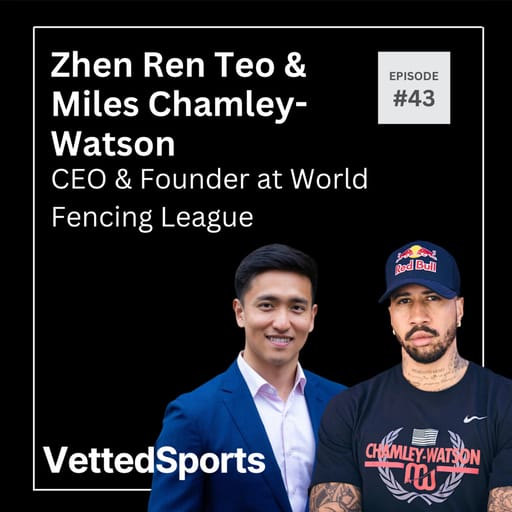
Transcript 0:00 [gentle music] Myles, Zhin, appreciate you guys joining today, man. 0:14 I'm super excited to talk about all things World Fencing League, um, but I wanna start with the origin story. 0:21 Um, talk about the moment that you guys both realized, um, you know, this needed a, a structured global professional league instead of just competitions every four years as, as we usually see with fencing. Yeah, yeah. 0:34 I'll start it off, Zhin. Uh, nice to meet you, my man. Sorry I'm a little nasally. Never get sick, but, um- All good. All good. [laughs] Yeah. 0:41 So I think for me it, it's, it's been in the back of my mind for years now, but I think the kind of the, showed what the camera's back was probably at the, the Olympics in Paris. 0:49 Um, because not only was I realizing that the audience that I brought, but when everybody came to fencing, they loved it. 0:55 And they were almost so cool, and I think that the biggest thing was people just never really had the opportunity to see it, um, unless it's, it's the Olympics or World Championships, kind of. 1:04 Um, I was sitting there and I was like, "Wait, how is there no, quote unquote, real professional league," right? 1:10 We have our World Cup circuit, our Grand Prix circuit, World Championships, but it hasn't changed the last 20 years. And, you know, other athletes in, in Asia and Europe, they're all government-funded. 1:21 But it's still like, list- you know, if you're number one in the world, you shouldn't have to, you shouldn't have to work a second job, in my opinion. 1:26 So a lot of guys on my team who are, you know, ranked decently high in the world, they have another job, they're in finance. 'Cause at the end of the day, you have to make money, right? End meet. 1:34 And kinda take me out of the equation, uh, you know, fencing's kind of, if you can get a sponsorship endorsement, then it's, you know, pretty lucrative. 1:42 But I'm the only one in America that kinda has, has, you know, quote, unquote, reached out and become more of a name beyond just fencing. 1:50 So, you know, I was in a call with Karwan Sports, and Zhin and Leo, my two, you know, Zhin, Leo, and Carl, who are my co-founders. 1:56 And I was like, "Here's," I was like, "Here's my idea," and kinda all their eyes opened, and they're like, "Okay, keep going, keep going." And then I was just like, "Listen," like, "How do we create our version of UFC? 2:05 We're gonna lose integrity to the sport, but finally parents and kids can invest," right? Because now parents can say, "Okay, cool. There's an end goal for my kid now." 2:13 Kids can say, "Look, I wanna be like Myles, whatever, and join the WFL." 2:16 So now for the first time there's an actual roadmap to getting from grassroots level, being, you know, 12, 14, to if you can't make the, you know, the Olympics, you can still, you know, compete in the WRL if you are obviously, if you, you know, meet, meet the requirements. 2:30 So I would say last three years, but really it was after the Olympics, which I was able to, you know, find my, my, my, uh, co-founders. Yeah, for sure. For sure. 2:42 And, you know, fencing is one of the oldest sports in the world, which a lot of people may not know. But, you know, I feel like it's always struggled to kinda reach mainstream visibility and publicity. Why do you... 2:52 What do you think has held it back from really bacon, breaking through culturally, and why hasn't somebody tried to build something like this before? Yeah, I'll take this one, Zhin. [laughs] Um- Yeah, go ahead. 3:02 I think the biggest, the biggest aspect is the understanding and the tech aspect. Because even my mom watched me compete, and she's like, "Where'd you hit?" You know? 3:11 And I think because it's so fast, and like you said, it is one of the oldest sports, especially in, in the Olympiad. 3:16 And we realized that in order to understand and get the audience, we have to change the way the sport are being viewed, and that comes from tech, immediately from tech. Um, which is why we're so, 3:27 you know, the tech aspect is so important to us because I think that will make people understand the sport, but also to show it in a really cool way. 'Cause most sports have grown, right? 3:35 New camera angles, new POVs, but fencing's kinda stayed the same, which is just these angles from the end of the strip. So much happens in the middle, we, we don't get to see. 3:44 So that's why we partnered with Dentsu, Japan, who created an AI blade tracking, which for the first time athletes and audiences will be able to see someone getting hit, which is gonna be incredible for... 3:56 You know, imagine like a little kid seeing, imagine seeing a coach seeing it, or seeing a fencer seeing it, or seeing an audience see it. 4:00 So this is gonna be the biggest change immediately in the sport, which I think is what was missing, just the understanding of what fencing really is. Yeah. Yeah, just, just to add on to that as well. 4:11 I think it's so important to really look at it in two angles, right? So Myles came in, and I think that's where, I've heard him talk about this story 100 times now, and I'm still- [laughs]... 4:21 inspired every time [laughs] he mentions it. Yeah. 4:23 About how from an athlete perspective, he started with this sport, he grew the sport, and now he's thriving in this sport, and how he has perceived fencing, um, as, as something of a product, but it's really half-baked if you ask me. 4:40 Um, and how from now a non-fencing perspective, we came in as Karwan Sports Group, um, like, uh, what Myles, uh, Myles mentioned, the, the different co-founders, um, came to really brainstorm on how can you actually add in new additions to really produce and visualize the way fencing should be visualized, right? 5:01 Ultimately, it's, it's sword fighting at the bare, like, minimum. 5:06 It's, it's two person dueling, and it's exciting, it's skillful, it's fast, uh, it's raw, and it's really not being shown and produced this way at, um, currently in traditional media. 5:20 So I think what Myles mentioned, it's something which we looked at at first principle. What were the problems with fencing at the moment? 5:29 Maybe not fundamentally, um, having some issues, but more of how can we actually add that element? 5:35 So I, I think that's really crucial in building, um, this league and how we, we truly see fencing going from niche to mainstream. Yeah. It's really bridging this, this, um, this gap that we see. Yeah, absolutely. 5:49 Absolutely. Zhin, I, I wanna, I wanna swing it to you for a minute 'cause, you know, you guys got involved in this and, and obviously you see a lot upside and potential in, in the league, uh, globally. 5:58 So why, talk about, like-The structure of the league, how you guys are thinking about it, um, and also why you decided to start globally instead of maybe localizing the sport, um, or the league to, to begin with. Yeah. 6:12 I, I think launching any league, right, no matter how small or big, it's, it's so difficult, it's so challenging. 6:18 And now you talk about trying to launch a new league that has been historically around for hundreds of years. Yeah. Right? Uh, a core Olympic sport. So it's not just about simply building an event. 6:32 Now you've got to build trust. Mm. 6:33 You've got to build the relationship and trust from fans that have been around for, for hundreds of years, as, as we mentioned, that have both from grassroots level all the way to the elite level. 6:46 So I, I think we realized quickly with Mouse that it's not just trying to start small. If you try to disrupt something as big as fencing, you, you need to start big and start global. 6:58 Um, and I think that's, that's, um, our key aim. 7:01 Um, when we went into it, we decided that if we are trying to change fencing and not, not disrupt it completely, but add an element and add a, a new layer of excitement to the sport, I, I think it's something where we fundamentally realized that it has to transcend, um, not just a small city, but, um, the whole global, uh, sport of fencing itself. 7:25 So this way, we not just get the maximum eyeballs to the sport, but you bring in the best athletes in the world as well. Mm-hmm. And ultimately, that's what all sports fans want. 7:37 You don't want to watch Division III football. You want to watch Champions League. Yeah. Yeah. So it's the same for fencing. I, I think we want to watch the Mouse Chamblee Watson of fencing in all weapons, right? 7:49 Both genders face off- Yeah... and I think that's where you get the real stakes in the game, and that's where you get people excited and willing to watch and want more. Mm-hmm. Yeah, exactly. Yeah. 8:01 I think the timing is great, too. I mean, we're seeing a lot of emerging leagues, but you also have your legacy players in here domestically. 8:07 You look at like what the NFL has been able to build and the NBA and, and how they're expanding globally. 8:11 So when you look at other leagues, um, domestically and even globally, um, did you guys borrow any lessons or takeaways from how other leagues are structured or some of the things and strategies they're implementing as well? 8:25 Yeah. I think I'll get in touch quickly. I think, um, obviously, you know, I've got some friends who started the Snow League, the PLL. Yeah. But for me, it's, it's... 8:33 Fencing is very interesting because the culture, they know the sport, right? Where kids might be picking up a snowboard and, and kind of the understanding aspect is there. 8:40 You don't have to unders- you don't have to teach them, right, how fencing is, how it's the future. So that's why we're different. But also we're in a, in a luxury space because the people that are normally fencing, 8:52 right, are kind of upper scale, uppity, kind of, you know, well, wealthy working class, but we're also trying to bring a new audience in. 8:58 So that's when I come in where, you know, came from no money, came from London, was a bad kid, got into fencing as punishment. All my teammates' parents fenced. 9:07 Dad was on the Eaton's Club or Harvard, whatever that might be. So we have kind of two audiences, which is very unique. So that's why we kind of have... It's a blessing. 9:16 I don't think there's any curses, but I think it's more of a blessing because now from the grassroots level, we can educate completely new kids, right? 9:23 Whether it's like, whether it's the girl in the hood with Sim Dog, and I show kids and, "Oh my god, this is cool." All it is, is showing and the exposure. So that's kind of why we're different from most leagues. 9:31 But also fencing and tech hasn't really changed yet. So we as the WFL have the, have the, uh, kind of roadmap to kind of where we want to see the sport grow because technically it's, it's in our hands. 9:44 And one of the nicest receptions was when you start a league, right, a lot of athletes, you think they're big time, like, "No, no, I'm not joining it. No, no, no." 9:51 But every top athlete in the world has been like, "Can I join? Can I join?" 9:55 Which has been really, really nice and exciting me because we've got Olympic champions, world champions from everywhere in the world competing in our first, uh, debut in April. 10:02 So the fact that they understand what I can do and the fact that they are supporting me is very, is very, very nice and important. 10:07 Because sometimes you do get a lot of backlash from other players, other fencers because they're, "Oh, I don't know." So that's been really, really nice. 10:14 It's all the best fencers want to join, which is why it's very different from other leagues. Yeah. And I, I think Mouse is also, in a way, under, underplaying the, the amount of pull that he has. 10:26 Um, it's, it's really been quite eye-opening, uh, [chuckles] the, the type of caliber of, of characters that we have met over the last few months alone, right? 10:35 From, from celebrities to athletes, um, to, to big investors and all. I think every time we tell this story, um, their eyes sparkle, right? 10:45 You see, you see something which I think people realize the, the excitement in building a historic sport. Uh, it's, it's not common. And, and we do see this, um, at time to time. 10:58 You, you see like what Mouse mentioned, he, he has g- um, good relationships with, with the founders of Snow League, right? 11:05 Um, when, when someone tries to bring something new to a sport, I, I think everyone gets excited for a minute. Yeah. 11:11 And recently, over the past two years, I would say, we have seen a proliferation of new sports leagues come out, right? Everything from basketball to tennis to, to motor sports and so on. 11:25 So I think right now what we are trying to do is, yes, we try to bring the best from, the best learnings from different sports, not just from sports that have existed for many years now, but from the new leagues that are coming out as well. 11:40 What are things that they're doing differently that we can learn from both the, the positives but also the mistakes that they've made? And I think that's how we are building this league. 11:50 It's being very careful and pragmatic in what can be possible for our first debut event. And it's a iterative process, right? The debut event is the first event, but we are here for the long term. 12:01 So from there, we learn, and we continue growing and scaling the league forward.For sure. No, I love it. I love it. Myles, you said something interesting, man, I wanna, I wanna double back on. 12:10 You talked about how you got into fencing originally, and it was punishment. And it made me think about, like, an athlete's story. 12:17 And a, a lot of times fans fall in love with athletes because of their backgrounds, where they come from, the, the, the trials and tribulations, and, and that's what makes sports appealing in, in many regards. 12:27 So how important is storytelling of the fencers in this league and how you guys are trying to showcase them? I think it's very important, right? I think people just wanna have something to invest in, right? 12:36 And you take F1, for example, right? They can be the last driver on the grid, but if they're from your country, you're rooting for them, right? Right. Or if you like their shoes, their energy, you root for them. 12:45 So I think now, obviously, creating a league was the most important thing, but I think now it's how do we show the audience who these fencers really are, right? 12:53 You may know who I am, you may not, but I think the story behind each athlete is really, really cool because you get to learn how they got into fencing, how they're so different from you, how they're so... 13:02 You know, but they have the same common love of fencing. That's why it's such a unique sport, because there's no, there's no body type in fencing, right? I'm six five, you know, two ten. 13:09 Some guy can be five four from, from Japan and win. So I think that's why fencing is so cool, because it has no real body type, no real background. 13:18 I think that's why it's cool, because we can trust somebody from, from Italy, who their dad was, you know, a fencer, an Olympic champion. 13:24 He gave his kid a foil when he was four years old, and then it's in his, it's in his family. 13:28 So I think the storytelling is really, really important just because it gives the audience and the fan base someone to invest in and someone to follow. Yeah. So I think, I think it's very, very important. 13:36 And, and I think we've got time, but I think it's gonna be really cool to kind of give the fencers a w- as well a platform. 'Cause and I'm lucky, right? There was lots of outside, but- Yeah... 13:45 it makes me happy to see fencers kind of get the love that, that they deserve as well. Yeah, absolutely. And Zhen, for you guys, um, from the business side, how are you thinking about monetization? 13:56 'Cause obviously, you know, you start a league, the hype is there. 14:00 Um, you know, you, you may get, uh, y- people interested, but thinking long term and the strategy and building actual sustainable business, like what are you, how are you guys thinking about the economics of the league? 14:12 Yeah. I, I think, again, going back to first principles, like we, we are trying to structure this like a modern sports property. 14:19 Um, I mean, ultimately fencing at the moment does not have a viable commercial model, um, as you will. 14:26 There, there is, of course, the federations that exist right now, and fencing is in the Olympics, and we know that that brings in money. Uh, but there isn't a professional league at the moment. 14:36 So I, I think we had to look into it and see how can we actually take fencing to the big, the big boys, right, as you will, um, where we can actually play the same game. 14:45 So you're making revenue the traditional way of all sports properties do. So that's, that's from media to sponsorships to ticketing to merchants, uh, merchandise sales. 14:54 So I, I think we are trying to cover that first, but the big fifth element, right, as you will, is the tech aspect, which Myles have spoken about it. 15:04 I think we are trying to push that angle really hugely because I think that's gonna be massive for the sport. Um, when you're looking at it, it's not just purely the visualization aspect. 15:14 So there's the production layer where we are adding not just the motion capture of the blades itself and the AI scoring of the, the refereeing of the bouts itself, but it's also how can we actually look one layer deep- deeper into the different layers of tech that we can integrate to make this not just a sports league, but a tech company a- as a whole. 15:37 So you're talking about everything from tracking of biometrics of the athletes itself to integrating new hardware for s- the, the piste where the athletes are fencing. 15:48 How can we actually track the movements and actually gain and generate data that's useful, um, for not just the fencers, but for fans itself that want to follow the sport that they love? 15:59 And then ultimately as well is seeing what are other way that we can license our new products that we develop and continue growing, um, as we look to scale the league, um, upwards. 16:11 So I, I think that angle is something which is really interesting. Um, and tech goes beyond this, right? 16:17 We look into gaming as well, and how can we actually elevate the sport and transcend it not just to sports fans, but to gaming fans as well. 16:26 And I think there's a lot of things which we'll try not to share too much- Yeah... 16:30 during this, um, this podcast interview, but I think going forward you will see a lot of movements in this space because I think ultimately that's where we want to be. Mm-hmm. Yeah. 16:41 And then looking, looking, you know, you guys are, you know, a few months away from launch here. 16:46 When you look, um, maybe in a one-year outlook, what, what would you define as success for like that year one of the league? Is it like viewership? Is it sponsorship interest? Is it a certain revenue number? 16:57 Like what would you guys deem as success year one for, for the league once you guys actually get it off the ground? Uh, well, I mean- I'll let you go Myles first because I know your definition is different than mine. 17:08 [chuckles] Well, I, I already know it's gonna be a success 'cause I'm involved, and so is my brother. I like it. So far. But I think obviously, pr- right, we need proof of concept, right? Just in terms of from 17:19 sponsorships, from TV rights to understand, okay, wow, he brought this amount of people, these amount of impressions, these are the people that went to the event. This is the... 17:26 Like what else did they do different than every, every other competition? So, so on and so forth. So I think for us it's the eyeballs, but also the response is gonna be very, very important, right? 17:36 Because that's how you get TV rights, right? Is it, sure, a lightboard audience in with, with, with, with no TV rights. And I think it's also bringing a whole new audience into the sport. 17:43 I think it's gonna be very, very important as well. All the people who wouldn't... 'Cause I already have the fencing audience. Like I have that already. 17:49 So the whole point of growing a league is you need other audiences to grow, right? Whether it's having LeBron here or whoever here to kind of showcase the sport and say, "Oh wow, this sports league is amazing." 17:58 'Cause not only is it really, really cool, it's also giving the future, the next generation an, an end goal and a roadmap. 18:05 I think that's why-It's gonna be very successful is because we have so many different kind of entities within the league, right? It's, it's, there's NIL, there's having a draft, there's having teams. 18:15 There's so many different ways that we can go, which is why it's really, really, really exciting. So I think for us, it's proof of concept, which I think is gonna happen. 18:21 But also, I think just showcasing the new tech will be, will, will be pff more than enough right away, 'cause that's never been seen before. 18:29 And all brands, sponsorships, TV rights, they want to see something that's new, but it's an old sport, right? 18:36 So we kinda have that kinda angle, the oldest sport, but we're changing it to the most tech-savvy league there is. 18:41 So I think that's, that's, that's the big difference between us, and I think that's why it's gonna be a massive success. Mm-hmm. Massive success. Yeah. 18:50 I, I mean, e- everything that Mouse said, but I think a, a, a big one which I've shared with the team is this simply, right? 18:56 I, I, I task everyone, um, who's hearing this right now to go on, um, YouTube and just search any fencing video you want, right? And you'll see the top comments being, 19:08 "I, I don't know why this person won," or, "Why is there two lights?" Or- Yeah... "I don't understand what's going on." 19:14 So I, I think these are the very common comments that we see in all videos or everything that is related to fencing at this stage. 19:21 So for me, success would be simply any World Fencing League video that goes on YouTube, it will be simply comments such as, "I finally understand this now," or, "Wow, this is so cool. It captures fencing in a new light." 19:36 So comments like this, I think if we can get a few of this, you really start showing that there is traction, and people, and the audience, the fans are- Yeah... buying into this. 19:48 And I think that's, that's where you start being excited, being, um, telling yourself and telling everyone that, "Well, um, we are building something special here." Yeah, exactly. I love that. Total- I love that. 20:00 La- last- Good job [laughs] Last question before we wrap up here, man. 20:03 If we, you know, we, we looked at the one-year period, but if we fast-forward 10 years from now, what do you hope people say about the World Fencing League and how it changed fencing, or how it changed sports more broadly? 20:15 I got this, Zhin. Um, [laughs] I think in the next five years it is not only gonna be the sole reason why kids fence, but also it will finally be a league where people can do one thing, which is just worry about fencing. 20:32 Not worry about getting another job, not worry about getting into college. 20:34 There's finally a end goal that you can finally invest yourself being 16, "I wanna be a part of the WFL, because not only will I make money, I will be n- I will finally get the love and respect I deserve as an athlete," which is what most athletes want, right? 20:47 It's why there's such a pull in w- women's sports, which they want, 1000% need that. But it's eyes, visibility, and giving athletes the opportunity to just become a professional fencer. 20:58 And it's gonna show the sport that's not like The Parent Trap, right? It's real, real combat. 21:03 And I think through this new fencer AI blade tracking, it will show the whole new audience how amazing the sport that gave me everything is. 21:11 I think that's why the next five years fencing will be one of the most watched sports. Mark my words. Bang. I love it. Zhin, you wanna add anything or is that mic drop? [laughs] No, no, that's mic drop. You got it. 21:22 [laughs] Guys, man, I appreciate y'all time, man. Y'all are, y'all are doing some amazing things. 21:27 I'm, I'm, I'm, I'm, uh, honored to have you on the, on the, on the show, and then I'm even more excited to see how the league turns out and hopefully get to witness it in person. 21:35 But, uh, last and not, but not least, let people know where they can find out more about you guys, but also the league. Yep. Um, yeah, I'll, I'll go with that. So you can search our website, www.worldfencingleague.org. 21:48 Um, we do have a Instagram page as well, just search @worldfencingleague. And we are soon to be on all socials, so I would say follow our Instagram page for sure. Follow Mouse, I think that's very important. 22:01 And yeah, hear us on the press, because we'll be on it, um, very soon. Yeah. I can't wait. Thank you for your time, man. And if you're in LA, brother, we'd love to host you, so. Absolutely. Absolutely. 22:10 Appreciate it, guys. Pleasure. Thank you guys so much. Thanks for having us. And, uh, World Fencing League. You, you see that? You see the merch, Tom. [laughs] Let's go. All right, guys. Thank you so much, man. 22:21 Have a lovely day, everybody. Crush it. [outro music]