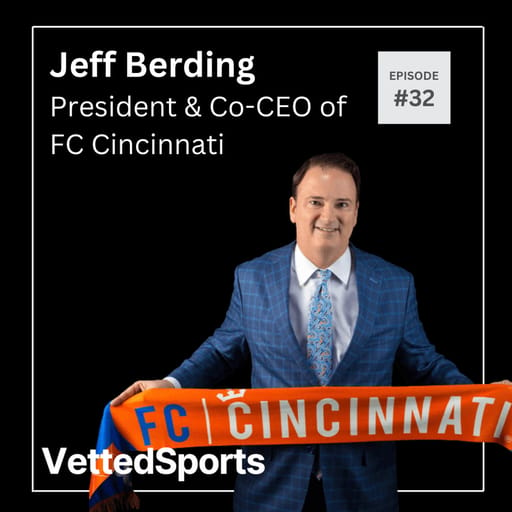
Transcript 0:00 [funky music] Yeah, first and foremost, I appreciate your time today. 0:15 I'm excited to learn more about your story, but I wanna start from the top of your FC Cincinnati journey. 0:21 Uh, what ultimately inspired you to leave your position, you know, after being with the Bengals for over 20 years, to go and launch a new franchise in a new sport, an entirely new league? 0:31 Like, what was the thinking process there for you? Well, you know, it's funny. Marvin Lewis, who's a good friend, he was the Bengals' head coach, of course, for 16 years. 0:39 When I told him I was leaving to go start a soccer team, he was like, "Seriously? You're leaving the NFL to go start a soccer team?" Uh, so yes, I understood it was a little, uh, non-traditional. 0:48 But, you know, for me, I grew up in Cincinnati as a huge fan of the Big Red Machine, and I love baseball and, and it inspired me to dream big. Maybe someday I would play for, uh, the Cincinnati Reds. 1:01 And my kids were growing up here loving soccer. They played soccer. 1:07 And, uh, my son and my younger daughter were really good players, and I just thought they were missing out, uh, on that sort of civic connectivity to, for their hometown, not to have a team in their sport. 1:19 And so, yes, after, uh, all those years at the Bengals, I felt I knew a little bit about the business of, of professional sports, and I had served on Cincinnati City Council for six years. 1:31 Um, I had become the president after I left City Hall, uh, of my kids' youth soccer club. 1:36 And so I sorta had a little bit of different pieces that would en- e- enable me to, uh, think maybe, uh, uh, uh, somewhat audaciously, I could pull this thing off. 1:47 And I wrote a business plan, uh, to create FC Cincinnati. And, uh, I was looking for a place to play after the Reds and Bengals told me, "No, thanks." 1:56 And I went up to the University of Cincinnati and met with the president of the university and the athletic director. 2:01 And next thing you know, in January of '15, I get a call from Carl Lindner, who's-- Uh, the Lindner family is sort of the first family of Cincinnati, a huge ph- uh, philanthropy in town. 2:11 And of course, the family had owned the Reds before they sold it to the current, uh, owners, uh, Bob Castellini. And, uh, he said, "Listen, I'm a big believer in the future of soccer, and I... 2:22 And, um, my kids played, and I'm pretty passionate about seeing it happen in Cincinnati. When I heard about your business plan, I wanted to ask, could I be your partner?" Uh, and, um, I li- I joked with him. 2:32 I said, "Well, you know, you're on the list of people I was gonna call." And I had lunch with him the same day he had me come over to have lunch, and we shook hands, and, uh, that was in January of '15. 2:42 By August, uh, I had left the Bengals and, and, uh, we launched the team now 10 years ago. Incredible. Incredible. 2:49 So when, when you think about that, that transition, what lessons did you take away from the NFL from working there all those years over into, uh, you know, w- when the, the team was in the USL and, and kinda making that, uh, you know, that, that transition as well, like from a, from a lessons- Sure... 3:06 or leadership perspective? So, uh, w- I think the biggest thing was we were starting as a, a USL team, a United Soccer League, so a minor league team, but we ran it like a major league team. 3:19 So w- I, I-- we weren't gonna do anything that s- screamed minor league. So as an example, all of our games were on TV. Uh, the Reds and Bengals are on TV, so of course FC Cincinnati's gonna be on, uh, TV. 3:33 Um, uh, some things I learned, uh, from Marvin, you have to take good care of your players, uh, because, you know, the, the players are never gonna give you their very, very best if they don't feel you love them. 3:45 Uh, and, uh, that, that was a, a, a key, uh, understanding from Marvin, where when I was at the Bengals, I tried to be the guy in the-- that would come down to the locker room. They joked, "The, the suit." 3:56 I was the suit in the locker room. I, I wasn't there to ask anything of them. My thing was you'd be happier in Cincinnati. Maybe they wanted to go to a show. Uh, maybe they were looking for a, a place to live. 4:09 Uh, maybe they needed a car dealership, uh, that they could g- uh, get a good car a- at a, at a good, uh, at, at a good deal. 4:16 So, um, take good care of your players because that'll, um, foster a heightened level of connectivity that usually leads to better performance. 4:26 Um, you know, some of the things we did a little bit differently than at the Bengals, we really leaned into community. 4:33 I, I said when we, um, founded the team that our three core values were gonna be we wanted to be a winning team, a family-friendly, inclusive club, and a franchise that gives back and makes the community better. 4:47 Uh, we were gonna be givers, not takers. Um, and I thought that if we did all three of those things well right out of the gate, that there was a... I called it a lane. 4:57 There's a lane for us here in Cincinnati where, you know, uh, I'm a lifelong Reds fan, blessed to work at the Bengals, uh, nearly 20 years. 5:06 But I, I felt like if we could do those three things consistently, people would look at us in a way that gave us a shot to be relevant in the Cincinnati sports scene. Uh, and, you know, um, it, it just, it worked. 5:21 Um, the league average attendance was 3,100. Our first game, we had 14,000 people show up. Our second game, 17,000. Our third game against Pittsburgh... 5:31 Um, I don't think owners belong in the locker rooms before the game. 5:35 But I went into the locker room before that Pittsburgh game and said, "If you wanna be, uh, the team that takes over this town, you, you wanna earn credibility in the streets of Cincinnati, be 5:46 the team that beats Pittsburgh." Mm. Uh, and, uh, clearly, you know, that came right on the heels of the Bengals losing the playoff game, uh, a- against the Steelers. 5:54 Uh, I had Bengals players who I was friends with, Domata Peko, Gio Bernard, Carlos Dunlap. 5:59 Uh, th- they were the honorary captains for the game, and our team went out and just pummeled Pittsburgh.Couple months later, s- same first year, we drew 35,000 people for a friendly against Crystal Palace. Wow. 6:14 And so, um, you know, that kind of organic growth by le- leaning into those values, uh, really worked, uh, for us right out of the gate. That's beautiful, man. 6:25 Community is so important, especially when you're, when you're getting it, getting it off the ground. 6:29 And when you think about, like, the, the, the transition from USL to MLS, like, what was that like behind the scenes, and what was kinda the impetus behind making that move? 6:38 Well, our business plan from the very beginning, and we said it at the launch, we wanted to be Cincinnati's third major league team. 6:45 But, um, you know, Don Garber had, uh, told Carl Lindner and me, "Uh, in- invest 6 million before 600 million." Mm-hmm. "Have a proof of concept." 6:56 And so the USL was our opportunity to prove the, um, the concept that professional soccer could work in Cincinnati. But the intention was always to very quickly get into Major League Soccer. 7:09 I felt we were onto something in terms of the growth of, uh, MLS and soccer in our country, and I had the data to back it up from my days at the NFL. So, um, we, we were in a hurry. Um, our slogan was, "Rise together." 7:24 We were giving our fans the opportunity to be a part of something bigger than themselves, to literally create a Major League S- Soccer team, a third franchise from scratch. 7:35 You know, normally we just ask the fans to come to the games. Here, we were asking fans to help literally propel us into Major League Soccer, and on the quick. My point being, I, I thought we were ahead of Miami. 7:46 We, uh, we were ahead of Nashville. We were ahead of Charlotte. Uh, we were ahead of Indy. We were ahead of, uh, Phoenix and Vegas. 7:54 We were gonna be bigger and better than Sacramento, respectfully, which was, at that time, the big dogs in, uh, the USL. 8:01 And I felt like the quicker we, uh, were successful and sort of forced Major League Soccer's hand to take us, it would be before those other markets that maybe, uh, uh, to some might be more desirable, before they completely figured it out. 8:18 Mm-hmm. So after our first year of, uh, success, we were invited to be a part of, uh, the MLS expansion process. Uh, we came up with a stadium plan. That was the year we went on that epic Open Cup run. We beat, um... 8:33 You know, that's like, uh, March Madness in the middle of your season, where the 16 seed has to play the one seed. Yeah. And then if you beat the one seed, then you gotta play another one seed. 8:41 So we beat Columbus Crew, and then we beat Chicago Fire, uh, and then we beat Miami. Uh, and, um, all in front of 30,000 people. Mm-hmm. 8:51 And so those matches really proved to Major League Soccer that, uh, uh, FC Cincinnati had what it took to succeed in, in, in MLS. Well, 9:03 2018 we had to, at the beginning of the year, we had to develop a stadium plan for downtown, 9:09 um, it, which then led to the award where we were 23 in a row unbeaten, uh, which was a record, uh, at the time, and won our first trophy. 9:17 But what I would tell you is, you know, it also leads to some, uh, challenge, because, you know, when Charlotte gets a franchise, they get three years before they play the first game. St. 9:27 Louis, three years before they play the first game. Nashville, two years before they play the first game. Cincinnati, we had 270 days. Mm-hmm. So, you know, we had a very quick transition into MLS. 9:40 Now, to be fair, I just told you, we wanted to go quick. Yeah. 9:44 But I, I think, uh, the expectation would've been they would've picked us, and then maybe we would have had a, a, a second year to sort of get the soccer side right. 9:53 But listen, you, you sometimes, um, learn while you lose, and you, uh, build character by overcoming adversity. Uh, and we certainly had that challenge, uh, for us here in Cincinnati. For sure. 10:08 And y- you, you, you think about the fandom and the attendance and how people show up for the team, but then also you're talking about the Bengals and the Reds and, and this whole community that gets behind their teams. 10:19 What makes the culture, the sports culture in Cincinnati so special? 10:23 Well, you know, I think, um, for the, you know, the, the cities our size, and my point being, you know, Philly is Philly, and Boston is Boston, New York, Chicago, LA, right? 10:36 Like, those are the top markets in, in, in the country. But for the next level down, our sports teams really help build the brand of our city. 10:45 Out of college I, I used to, uh, work up in, uh, Cleveland, and, you know, their, their teams had struggled. And, uh, there was, you know, a joke, "Oh, the Mistake on the Lake." Well, LeBron won an NBA title. 10:57 They're now, now called Believeland. Yeah. So cities our size, you know, the brand can be the sports teams, where there's a lot going on, a lot of great things here that most people don't know about. 11:08 But the sports teams, you know, w- when they start winning, that's, that builds a different brand. This is a winning city, a championship city. And we, we feel like we own that. 11:18 We own that obligation to lead, inspire, and unite our community and represent Cincinnati, uh, not just to the country, but to the world, because soccer is a global brand. There's real global currency in soccer. 11:31 And I think our fans appreciate the fact that, that we do take that on. And w- and, and, you know, our, again, our values of being a winning team, being inclusive. 11:41 You think about politics today, it's all about division, you know? Yeah. Building walls, making people feel like they don't belong. And in sports, we, we try to build bridges. 11:51 We want everyone to feel a sense of belonging, and we want everyone to feel welcome. That inclusivity is sometimes rare, uh, in, in modern society, certainly in the times that we're in. 12:03 And so I, I think that th- those values that we try to, uh, live by and representI think in a city the size of Cincinnati, which maybe sometimes, you know, we have a little bit of a chip on our shoulder, I, I think that that's respected in how we try to, uh, run FC Cincinnati. 12:20 You know, I always joke, I run our club like I'm the mayor of Cincinnati. If it's good for Cincinnati, I'll feel... I'll find a way to be supportive. 12:27 And it's good for FC Cincinnati, I'll make sure that people don't think it's not good for the city. I, I want our success and the city's success go hand-in-hand. Yeah, that's beautiful, beautiful perspective. 12:38 And, you know, looking ahead, obviously the World Cup is coming here next year. Um, it feels like a huge milestone and, and, and, you know, hopefully a huge growth, uh, growth step for the, for the game of soccer. 12:51 What do you think this means for, uh, the, the upside of soccer in America, and even more so for FC Cincinnati? Well, y- number one, you have to acknowledge the tremendous growth of soccer. 13:04 I mean, just to give you a sense, when I was at the Bengals in 2004, according to NFL data, soccer was not one of the top 10 sports in the US based on the ESPN Chilton Poll and Nielsen ratings. 13:15 By 2014, it had risen to, uh, fourth, uh, in those same metrics. Not MLS, soccer. Soccer. That's a lot of growth in, uh, just a single decade. Now you fast-forward another 10 years, there's, uh, 30 teams in MLS. 13:30 Uh, most of the top US markets have a team. Uh, an increasing, um, number of world-class players, uh, playing here, of course. You have Messi, uh, as, uh, uh, probably the GOAT. 13:43 But, you know, Thomas Müller, um, uh, Sonny, uh, what he's doing in, uh, at LAFC. Uh, you know, w- we continue to see more good players. Um, we have billion-dollar franchises. 13:58 Um, I think if you look at the good part of the Apple deal, um, 14:03 we have a, a, a, a high quality production with global transmission of our matches in a model that's like the NFL, where it is a, a national broadcast with the revenue, uh, shared equally. Mm-hmm. 14:19 And I contrast that to Major League Baseball, which MLS used to be more like baseball where every team did their own deal. You'd much rather be on the NFL model. Um, what I think happens with, uh, the World Cup is 14:34 you're gonna have the best players in the world coming into these top markets in our country, and in some of those markets, soccer's maybe not quite gained the cultural relevance, uh, that we need it to. 14:46 I mean, C- FC Cincinnati has glow- has real cultural relevance here but, you know, when you're in Boston, it's just harder with the Celtics and the Red Sox and the Patriots and the Bruins. 14:57 But they're gonna have some of the best players in the world in that market. You're gonna have probably four to six weeks of, of a lot of news every single night talking about soccer. The games are gonna be on TV. 15:10 And our belief is that we're gonna capture the attention of those American sports consumers who have not yet become fans of soccer. Mm-hmm. 15:19 And with that should be increased eyeballs maybe on MLS, and with that, new media rights, which brings more money, which allows us to afford more and more world-class players. 15:31 Because the thing that I think we have to acknowledge is the American sports consumer is spoiled because they have the best basketball players in the world, not the only, but the best. 15:41 NHL, the best hockey players in the world. They play in other leagues around the world, but the best are in the NHL, right? Baseball, the best are in Major League Baseball. But in soccer, the best are in Europe. Yeah. 15:53 And so in order for us to get the best players here, MLS is gonna need to go to a new level, I call it MLS 3.0, with, uh, an ability to build our rosters with more 16:07 world-class players, with ambitious owners, with additional revenue from media rights. 16:12 But I think it starts with those, well again, what I call American sports consumers who have not yet found soccer to go watch some of these games, go, "Wow, this is actually really exciting. It's really fun. 16:23 These performances are really, uh, inspiring. Uh, and the drama, uh, at the end of these matches is incredible, and this is something that I'd like to maybe watch a little bit more of." 16:34 And that hopefully becomes the hook for MLS to continue to grow here in the US and Canada. 16:41 Obviously we're seeing a lot of private capital coming into sports, and it's becoming, you know, obviously its own alternative asset class. 16:48 What does that actually mean to you, and how does that impact, you think, the MLS going forward? Well, um, s- sports is w- one of a kind, uh, in, in this country for a lot of reasons. 17:02 You know, 99 out of 100 of the top watched programs on television were sports last year. Um, you have to think about life and, and on a very human level. 17:17 You know, um, we have a lot of burdens, uh, in, in this world. Um, and sports provides an escape from those challenges, where you go into a stadium with your friends, uh, and again, you get inspired by performances. 17:32 You have the civic pride where you're rooting for your teams, and you feel a sense of belonging with those fans that you're sitting around. 17:39 You know, no one's asking you who you love or where you're from or where you worship. Uh, it's just we have this common, uh, connection around the love of our teams, and that's powerful stuff. Yeah. 17:52 And, uh, there's real emotion, uh, a- around it. Um, you know, people are looking for fun, and, um, uh, th- sports are fun. Uh, and, uh, the community impact that we can have, uh, is enormous. 18:07 And so I think for those reasons, it's sports are always gonna continue to be powerful. Um-You know, uh, the appreciated value of sports is unchallenged. Um, uh, sports continues to outperform the stock market. 18:24 Um, media rights valuations only continue to go higher, and I would offer with the, uh, d- diversity of, of channels, unlike just back when it was just, you know, the three networks or the four networks, you know, sports becomes even more compelling because it is the hook to all the rest of the programming 18:45 that you will see on those, uh, different networks. 18:49 So, um, for that reason, I think that sports as an asset class is only gonna continue to grow in its importance and its valuation, and m- my job is to make sure FC Cincinnati is well positioned to be a part of that. 19:02 And it's a good segue also into what you all are doing with Lion Ventures. Can you kinda talk about that initiative and how it got started and what the focus is for it? Sure. And how it relates to FC Cincinnati. Sure. 19:14 Well, um, FC Cincinnati is, is the soccer team, of course, but, um, we have a holding company that we've, uh, named Cincinnatus Sports & Entertainment, so that's our holdco. 19:28 And underneath Cincinnatus is the team co, right? FC Cincinnati, the stadco, uh, TQL Stadium. Um, we also have, uh, our, um, training facility, but we've added some things. 19:41 So Lion Ventures is a consulting company that helps us grow, uh, other sports, um, and, uh, to give us the ab- opportunity to do more in the sports ecosystem, um, and to get the most value out of our pretty substantial investment, um, uh, in our stadium. 20:01 So, um, we also have a, a pretty significant real estate, uh, project plan. Phase one, over $300 million just north of the stadium. 20:09 Right now we have a big hole in the ground, uh, but, uh, in the first quarter of next year we'll start coming out of the ground, um, uh, with, uh, uh, a ho- 13-story hotel, a 13-story apartment building, some destination retail, think of sports bars and team store and things of that nature, some office. 20:30 Um, but there'll be additional phases. Uh, we're working on plans, uh, for a new arena, an 18,000-seat arena with a site... 20:38 The leading site would be right across the street from our stadium, uh, which would take advantage of, uh, all the investments that the community and our, and our, uh, owners, my partners, have made. Uh, so, um, 20:52 w- we're continually looking for the opportunity to do more. 20:55 Lion Ventures has been hired to do some consulting work to help other people think through how they should approach, whether it is their facilities, uh, or their real estate, or just trying to sell naming rights, uh, to one of their buildings. 21:11 But we're, we're trying to take all of our experience and then our commitment to community, uh, and showing how sports can be a, a catalyst for growth, uh, and helping some owners who maybe don't have quite the level of experience we have in-house to help them solve, uh, some of their, uh, some of their opportunities. 21:34 Are there any, uh, specific, like, sub-sectors of sports that you all are most bullish and- bullish on or interested in, whether that's, like, youth sports or women's sports or even, like, y- looking at, like, mis- mixed-use venues? 21:46 Like, a- are there things that you're, um, super f- interested in or see a lot of potential in long term when you think about the asset class of sports? Well, Malcolm, all of the above. 21:57 [laughs] Um, we're, we're, we're, we're very interested in the youth sports side. We obviously have an academy, uh, but w- we are, um, quietly working, uh, on a, a youth, um, sports 22:13 facility, uh, fields and indoor, uh, and, um, to give, uh, families a- an opportunity to have first-class, uh, uh, facilities for their young people, but also for adults who still wanna play sports, um, uh, in their 20s and 30s and, and, and older, um, to have an active lifestyle. 22:35 We're very, very interested in, um, women's sports. I think it's known that we were a, a finalist for the NWSL, uh, before they chose Denver. We had Caitlin Clark in our ownership group. 22:48 Uh, we still keep in touch with Caitlin. We'd love to find an opportunity to do something in, in women's soccer, uh, together. 22:56 Uh, we are evaluating some other opportunities, uh, in, in women's soccer, both here and abroad. Um, of course, on the real estate side, uh, re- real estate creates, uh, is a place-based investment. 23:13 So yes, you have the stadium, but what we really want is to create a sense of place where, again, whether it's people living adjacent to the stadium, whether it's people staying in a hotel adjacent to the stadium, people coming to the bars and the restaurants, people working near the stadium, um, all, all of that creates a greater sense of place, and we think creates a heightened sense of civic pride 23:38 when the stadium isn't just a standalone, but is a part of a, a, a, of a, of a larger development. 23:45 And for us, we're in a neighborhood, the West End, a proud African American, uh, neighborhood that has real history in Cincinnati, uh, of, uh, some of the l- leaders in business and, uh, government, uh, and civically, doctors and lawyers, all lived in the West End. 24:05 And then of course, we know what happened. The federal government put the highway right through the middle of the West End and, uh, as a result, a period of decades of disinvestment and decline. 24:14 And we have a community benefits agreement, uh, with the West End, and w- we are outperforming every metric that we were asked to do-And, um, they are unanimous in their support for FC Cincinnati and our development plans because number one, they're at the table helping drive what that future looks like. 24:34 Their vision be- is our vision. Um, and, uh, we're being a catalyst for bringing, and this is their words, "We want good things in our neighborhood." Mm-hmm. 24:43 Um, and, and w- we are investing our dollars, but also bringing government dollars where appropriate, um, to create a neighborhood that people in the West End are pretty excited about. 24:54 And we c- we're, through Lion Ventures, helping other sports team owners think about how they can do something similar in, in their city, uh, or, um, in, uh, you know, for, for, for their project. It's amazing. 25:10 I, I love it, Jeff. Uh, last couple questions before we, before we wrap up. Uh, when you look back years from now, what would make you the most proud about what you built with FC Cincinnati and Lion Ventures? Wow. 25:26 Well, number one, we wanna win MLS Cup, 'cause I said that I thought the lane, uh, was, um, uh, was by winning. And let me be clear, I root for the Reds. I'm a season ticket holder, club seats right behind home plate. 25:41 I want the Reds to win the World Series every year, I want the Bengals to win the Super Bowl. I went to the Super Bowl where they lost to the Rams. Oh, tough. [laughs] So this is not... 25:47 I'm rooting for my teams, but let me be clear, I'm gonna do my part and I'm gonna do everything I can to bring MLS Cup to Cincinnati. We wanna be, uh, trophy, uh, winning again because of the brand of Cincinnati. 25:59 We want Cincinnati to be a championship team. Um, obviously this development, I, I wanna see all of this open, all the different phases. I want people in the West End proud. 26:08 I want people saying, "You know, FC Cincinnati was a force for good, uh, in this community." And then, you know, I wanna see Cincinnati grow. I want more companies here. I want more people here. 26:19 I want talent saying, "You know what? I, I don't wanna go to Philadelphia. I wanna go to Cincinnati because Cincinnati's a place where I can be successful. 26:27 Where, you know, there's a big, uh, corporate community with Procter & Gamble and Kroger and other top companies, and I can have the support I need to grow my business, uh, to be an innovator, to be an entrepreneur like Jeff Berding was with FC Cincinnati. 26:41 And we can make it work, and my family, we can be happy here in Cincinnati." 26:46 And if Cincinnati starts to get on that, uh, significant growth train, and I'll think that FC Cincinnati maybe was a catalyst for that new energy and that new ambition in Cincinnati, I'll have a hell of a lot of pride. 26:58 Jeff, that's beautiful. Um, what you're building is incredible, and the city of Cincinnati is lucky to have you as a, as a leader. Um, lastly, can you let people know where they can connect with you and learn more? Sure. 27:09 Um, fccincinnati.com is our, uh, website. Uh, and, uh, they can get more information on connecting with me on the website. And then I, I'd also encourage people to follow us on our, all of our social channels. 27:22 Uh, and, uh, you know, maybe come to a game and, uh, experience it firsthand. 27:27 Uh, TQL Stadium was voted the best soccer stadium in the world by the World Football Congress, better than Wembley, better than where the World Cup final was played in, uh, Doha in Qatar. 27:40 Uh, Gianni Infantino came and said, "I can't believe the best soccer stadium in the world is in Cincinnati, Ohio." 27:46 So for all of the folks listening and watching, I'd love to host you at a game, and, uh, let's have some fun together. Jeff, you, you, you sold me. I'ma be up there as soon as I can. [laughs] All right. 27:56 You're gonna be sitting in my suite, Malcolm, okay? [laughs] Sounds good. I appreciate it, Jeff. Okay. Take care. Thanks, everyone. Malcolm, thank you. 28:05 [outro music]