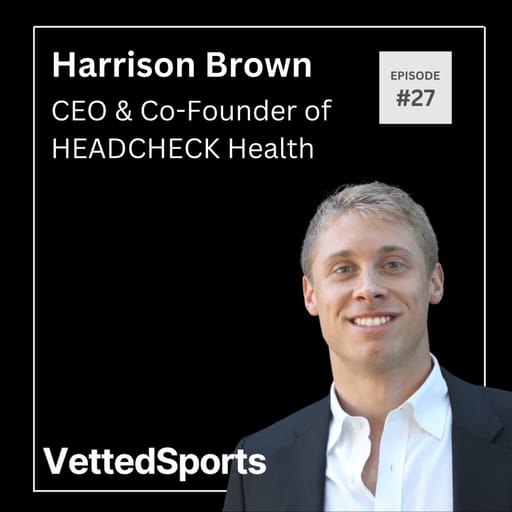
Transcript 0:00 [ on-hold music] Harrison, appreciate your time, man. Um, I'm excited to hear more about your journey. 0:17 Uh, to start, I wanna, I wanna take it back to the inception of Headcheck Health. Uh, give us the rundown on, like, how you even came up with this idea and when you actually saw it as a viable business opportunity. Yeah. 0:30 Thanks, Malcolm. Uh, so for me, this all started two thousand and twelve. 0:35 Uh, you know, I was sitting in a, in a crowd at Neuroscience Research Australia's main auditorium, and I was about to go on stage to make my first academic presentation. 0:46 So I was a master's student in a concussion research lab, and I was really nervous to g- to give this presentation because I'd been building a sensor-based concussion test that was more accurate than, than anything else that was out there. 0:58 And at these conferences, the, in the crowd is all the people that run the concussion research labs around the world. 1:05 And it's after the presentation that you have these interactions, and if they like your work and d- what you're doing, then they might offer you a PhD position, and then you can continue on, and we are gonna be able to continue to develop the sensor and, you know, solve this problem of, of concussion in sport. 1:20 Um, so I crushed the presentation, and then afterwards, I was disappointed because only three people came up to me. 1:28 Uh, you know, one was genuinely interested in, you know, the concussion sensor, and the other two just wanted to know if I knew where the bathroom was. 1:35 [chuckles] Um, so it, it was, it was that point where I started to realize that maybe building a concussion test wasn't gonna help me achieve my mission, which was I wanted to eliminate concussions from being mismanaged in sports. 1:47 And yeah, so I, I returned back to my university and accepted a PhD position at the lab that I was already in, and that was primarily because there wasn't other suitors. 1:58 Um, but I kept, you know, researching and building this tool and validating it and, you know, sinking hundreds of thousands of dollars into developing this test. 2:06 And, uh, yeah, one day, I'm, I'm sitting at my computer analyzing the data, and I, I start to realize, like, oh, wow, none of the data's actually correlating with the injuries, and we were collecting data with the football team. 2:19 Um, but also, all the other tests that the medical team was using were also not correlating with the injury. 2:25 And so I was really frustrated, so I flipped over to ESPN and started checking some, some football scores, and I saw the headline that changed everything for me. 2:34 A- and, and that was something along the lines of NFL is being sued a billion dollars for mismanaging concussions. Um, so that was in, in two thousand and twelve. And so I, I... 2:45 you know, obviously excited because, you know, I'm, I'm working on a billion-dollar problem here, right? 2:49 But I've also got all this data that's, that's just perhaps leading to the point that the test is not gonna be able to fix that problem. 2:56 And, uh, so I, I got really interested in the NFL lawsuit, and that was a, a domino effect for this industry. 3:03 So shortly after that, universities started getting sued, high schools, community sports teams where athletes were having their head injuries mismanaged, and now the athletes wanted to hold them accountable for it. 3:16 And when I started to dig into these lawsuits and look at the expert opinions and, and then the witnesses and whatnot, there was not a single case where the... i-it had said, "You used Malcolm's test for concussion. 3:31 If you had been using Harrison's test, then no- we all wouldn't be here." And so that was my first indication that, like, maybe the problem in the concussion space is not that there's a bad test. It's not a test problem. 3:43 In every single one of those cases, it was something completely, or completely different that led to the mismanagement, and that was that there was a mandatory protocol that didn't get followed. 3:52 And so it started to pique my interest on maybe the problem with this industry isn't a test problem, it's a compliance problem. 3:59 And so yeah, what we ended up doing at Headcheck is we built a system where organizations could do a hundred percent of their protocols, the tests, but also at this time, protocols were, were exploding to include spotter programs and, you know, uh, many different tests, different individuals involved in the care, clearance procedures, all this sort of thing. 4:20 And so our theory at the time was that there wasn't a technology to actually do all the things so that you could have the data to actually see if people were following the protocols. 4:29 So we built that, and we rolled it out with our first cohort of, of organizations, and we were shocked. 4:36 Um, something like thirty percent of the times a concussion happened were the players actually getting cared for according to that protocol. 4:44 And so again, w-we've now identified the problem here is actually a compliance issue. 4:48 And so what that means is that for every player in these organizations that had a concussion that was managed appropriately, there was at least another one that didn't, and that was gonna be-- they were gonna be exposed to all these horrible risks of head injuries. 5:00 And so we just got really good at one thing, and that was helping the organizations, of course, do their protocols and, um, measure compliance. 5:08 We were the first group that was able to do that, um, but getting really, really good at increasing compliance. So all of... 5:14 even today, our, one of our goals with our organizations is how can we get you to be a hundred percent compliance? 5:19 And we know if we do that, we reduce the risk for everyone, reduce the risk for the player, reduce the risk for the league, reduce the risk for the medical folks, and so on and so forth. Mm-hmm. 5:28 No, that, that's, uh, that's amazing, and, and it's, uh, it's a lot to unpack there. 5:31 I, I, I kinda wanna stick at the beginning of the story a little bit and, and talk about your conviction around this problem, 'cause- Yeah... obviously you've worked on this for a long time, ten plus years. 5:40 A-as you mentioned, hundreds, uh, uh, of thousands of dollars, you know, invested in, in this product and to, to build this company. Yeah. Uh, what gives you so much passion and conviction about this space? Yeah. 5:51 I, I think the w- it's the humans that are part of this, right? 5:54 Like, I'm, I'm not sure about yourself, but I know so many people in my circle that have had concussions and have had bad outcomes where, you know, they had to take time off work or, you know, they had to drop out of school or, or things like that, and it just, it tears apart families, right? 6:07 And the, the thing that really gave me so much conviction about going after this problem is that it's preventableRight? 6:14 Like, if the problem was that we don't have this fancy piece of technology that is, you know, measuring brainwaves and whatnot, then that's a really hard problem to solve. 6:23 But the problem was actually a lot simpler and, uh, to your point, um, it was a very unsexy problem, which is no, there's this list of things that experts said have to occur, and nobody checks because there is no way to do all these things and aggregate that into a fashion to be able to, to analyze it. 6:40 Mm-hmm. And can you talk about the business as, as, as, like, where it stands today? Like, what's the model? 6:46 And e- even more so, can you, like, present a case study of, like, how you guys are positively impacting athletes and organizations? Yeah. So we're a s- a vertical SaaS business, super niche what we do. 6:59 A lot of people probably don't even know that this type of technology exists. And so we sell a subscription to our clients on an annual basis, and that subscription is, uh, a factor of how complex their protocol is. 7:10 Um, so we're not trying to change their protocol. We're just giving them a better way to do 100% of it, and then use that data to figure out if they're compliant, and if they're not compliant, then, then fix it. 7:21 Uh, so yeah, we, we've got 20 staff at the moment. We're growing our revenues at about 50% year over year. 7:27 But the biggest thing I'd say is coming back to our mission of, of trying to eliminate concussions from being mismanaged, we're... 7:34 From our, our data, we're, we believe that we're preventing about 15,000 concussions from being prevented every single year, and at the same time, we're working with all types of organizations, so pro leagues, uh, amateur sports leagues, community sports leagues, high schools, colleges, and even crazy stuff like military. 7:54 And so if, if you think that something as, as strict as the military would have this compliance issue, you can just imagine how bad it is at the grassroots level. Yeah. 8:03 And so going back to the beginning, um, I, I wanna talk about, uh, you know, the, the, the, the... some of the challenges that you faced early on. 8:13 Like, can you, uh, can you talk about, uh, what was, what were some of the hurdles you had to overcome, whether it was, like, pivoting, figuring out what the root cause was, or even, like, mass adoption for the product? 8:24 Like, what were some of those early challenges like for you? Yeah. 8:27 I mean, the big one just from a founder's perspective was because I came from the science stream, like, I was a Masters of Science, and then I was, uh, in, in PhD studies, there was a assumption that I wasn't a business person and I lacked business training and, um, I was, I was never gonna be able to be, you know, the leader of a business. 8:47 Because I was, you know, a typical science-minded person, I was gonna want everything to be perfect before it launched. 8:54 And I think there's a lot of literature out there that says with, with companies like this, you gotta get the product out there, have customers use it, and then figure out whether it's actually delivering on the value that they wanted, and that happened to us, right? 9:06 Like, we, we were selling them a sensor to better test for one piece of a concussion, and that's not what they needed. 9:14 They came back to us and they said, "Hey, it's great that this one piece of the assessment is more accurate, but that's not preventing people from being mismanaged." 9:22 So we were forced to pivot probably five years, you know, a full master's degree, half a PhD, couple hundred thousand dollars with investor money. 9:32 Um, we were forced to pivot after all that, and in reality, we perhaps could have had that pivot earlier on and maybe save some money and save some time, but the only way that we were ever gonna figure out that that was the right pivot was learning from the customer. 9:47 And, and I think again, that comes back to the limitation that was put on me, which was I'm not gonna get this out in the world soon enough to get that feedback to make the right pivot. Mm-hmm. 9:57 What are, what are some of the differences in how maybe professional teams, colleges, uh, youth programs, and you also mentioned the military, how they view and handle concussion management? 10:07 Are there any nuances in, in how those different organizations or, uh, levels kind of m- manage the concussion protocol? Yeah. 10:14 I mean, the reality of it is the vast majority of concussion protocols at every level are fairly similar. 10:20 There's, you know, a recognize and report, and you might test for a diagnosis, and then there's a recovery phase, and then there's a clearance. 10:28 So every protocol, whether you're, you know, little kids or you're a professional sports team, you're, you're doing that, but you're just doing it in different ways. 10:35 And the biggest nuance is at the amateur level, these protocols are being executed by non-medical people, right? 10:42 So it's volunteer moms and dads that are also the coach and, you know, bringing the oranges to the sideline. They're also the person that is in charge in making sure that the protocol is actually followed. 10:53 And so the, the one thing I like to say about the youth market is when you drop off your kid to go play, I don't know, U7 soccer or U7 football, something like that, and the organization hands you a document that says, "It's safe to drop your kid off because we have a concussion policy," if you knew that only 30% of the time that was gonna happen, would you still drop the kid off? 11:18 A- and I think i- it's a reality that, like, we have to call this out for what it is, which is the policy doesn't protect the athlete. It's following the policy that actually does. 11:27 And at the amateur level, the gap is the biggest because they're non-medical individuals. And so we... you can't solve that problem by giving a non-medical person a medical tool to do medical testing. Mm-hmm. 11:39 It's these protocols have to be written so that a layperson can follow it, and perhaps they're triaging the medical aspects to the healthcare system. Mm-hmm. And what about misconceptions? 11:49 Are there any misconceptions that athletes, coaches, or even parents have about, uh, concussions w- within, like, let's say the youth, youth, youth sports ecosystem? Yeah. 11:59 I mean, even at the youth sports level y- you see a lot of parents that think their kid is gonna be a professional athlete, so they don't want their kid to miss time from having a head injury, right? 12:10 So there's always that motivation to play, to win, to be there when scouts are on the sideline. 12:16 And yeah, I would say one of the biggest misconceptions is that when somebody has a concussion, um, you know, they're gonna miss time, and they're gonna, they're gonna be out, and they're gonna miss those opportunities. 12:28 But the reality of it is there is-... publish data in the research world that says the earlier you remove a player from play, if they have a head injury, the quicker they'll return. And it makes sense, right? 12:39 Because let's say that you have a concussion in the first quarter of a game, if you're pulled out in the first quarter and you initiate the, you know, the re- the recovery process, you can make a full recovery and go back to play when it's safe for you to do that, and typically that's, you know, somewhere seven to 10 days, something like that. 12:56 Mm-hmm. 12:57 Um, of course, complex concussions can be much, much longer, but if you leave that player in and they play three more quarters with a brain injury, they could have another brain injury that puts them out for life. 13:08 And so I think there's this misconception right now that, uh, you know, organizations that adopt tools like this are gonna have more players pulled out and more players on the sideline missing those opportunities, um, you know, to, to go to the next level and, and be exposed to scouts, but it's actually the opposite. 13:25 If you pull the players out and you make sure that the right ones are, are, are put back in and the ones that are not safe to, to return are being treated earlier, they're gonna return to, to sport earlier in the, in, in the l- in the game or earlier in potentially the, the season, and they'll actually be exposed to more opportunities. 13:42 How, how do you feel about the narrative around concussions? 'Cause obviously you talked about the lawsuits back in, I think it was around 2012, and- Yeah... 13:49 we kinda saw a uptick in, in attention and awareness around concussions. Even the concussion movie came out, and I believe- Yeah... that was like 2015 or around that time as well. Like- Yeah... 13:57 do you think the narrative around concussions in sports is improving, or we still have a little ways to go to be where we need to be? So I think the, the awareness of it has drastically improved. 14:09 I think it's impossible to play a sport nowadays in, in the US that has concussions occurring frequently without hearing about it or without the organizations, uh, you know, talking about it or having a policy. 14:22 And, and I guess, like, what I would say is when business people, so folks that run, you know, leagues or, or organizations, they have to have an answer now for, well, what are you doing about concussion? 14:35 And just coming back full circle to the reason why we exist, the, the answer that people have been giving for, you know, since, let's say that, that, that movie came out is, "Oh, we have a protocol, and we brought in experts from the concussion research world to design the protocol so it fits our sport and fits our level of play." 14:53 Um, and then, you know, they pat themselves on the back and say, "Boom, we've, we've solved concussion," right? 14:58 But the reality of it is, is that not a lot of people are going to the next step, which is there's a huge difference between having a policy and following it, and I think that's where, where the biggest gap is right now, uh, and that's the one that we're, we're hoping to close. 15:12 Do you guys, uh, do anything in terms of education or providing resources to help, um, organizations or coaches a- and athletes who are skeptical about concussions, uh, understand the importance and, and some of the, I guess, the red tape around it? 15:26 Yeah. I mean, obviously you gotta, you know, acknowledge our market, right? Most of our users at, at a level, a higher level are medical folks. Yeah. But the buyer is a business person, right? 15:37 So if we're messaging to the medical folks, "Hey, you know, our tool is gonna make it easier for you to do your job and run these tests and manage the athletes," that's gonna tick a box for them, but the business folks don't care about that, right? 15:48 They care about risk. Um, and so the messaging that we try to give to them is along the lines of, this is a risk that you're gonna have to solve. 15:57 It's a critical problem, and you can look at us as almost, like, a ri- a risk reduction strategy. 16:03 So you can reduce the risk of having players mismanaged, which could lead to, of course, the worst outcome, which is a lawsuit, but it could also be bad PR, it could be bad word of mouth between parents, that sort of thing, that, that you are an unsafe organization. 16:16 And a- and again, that, that concept of, "Oh, but we have a policy," it's just not... it doesn't fly anymore. Mm-hmm. 16:23 What, what advice would you give to another founder who's building in, in a very niche space within sports trying to, um, you know, educate people on their product and get the word out there? Uh, can you... 16:36 If you had to go back, uh, let's say five, even 10 years ago, what advice would you have given yourself about, um, operating within this, in, uh, within this sector and, and building a company around it? Yeah. 16:48 I think it, it really depends on whether you're trying to replace a incumbent technology or whether you're trying to create a new category. 16:56 Um, and for us, we are trying to create a new category and, and we're trying to own it. 17:00 And, and so it's not like we're trying to say that we should be replacing the other companies that are out there innovating in the test space. 17:07 We're saying there's already enough people doing that, they're really good at it, you know, that's not for us. We're gonna try to innovate on a different problem, and so we actually have to work with these folks. 17:16 Um, but as a result of trying to create a new category, we also have to acknowledge that we're still sell- selling to the first, you know, 2.5% of people on the technology adoption curve, where these are innovators, right? 17:28 Like, they're not, they're not gonna do it because necessarily somebody else is doing it. They're doing it because they wanna gain an advantage or they wanna be the first to do it or they truly care about this problem. 17:38 And so if you're doing that, like we are, we have to go find who those people are. And, and the problem with it is that in the sports world, you don't know who the innovators are, right? 17:47 Like, you can't just draw up a list of, "Hey, these are our top 10 targets," because these are innovators, these are innovators, these are innovators. You have to get out there and you have to talk to them. 17:56 Um, the other thing that, that I think we, we did really early on was we just sprayed and prayed. 18:01 Like, we, we didn't know who the innovators were, so we just sent the message out there to the world, and the people that came back to us were, were the innovators, and I think that allowed us to get our first set of customers because they self-declared, "We are the innovators. 18:14 We wanna be the first to do this." 18:16 Uh, but at the same time, it, it, you know, if you're trying to sell to everybody, everybody has different problems, everybody has different values they wanna get, so it's really hard to deliver 100 different values. 18:29 If you can narrow that down to a much smaller market segment, like let's say that we had said, "Oh, we only wanna do this in football in the US," then the value that we'd have to provideAnd the speaking points on that would be so much more narrow than what we started with. 18:44 And, and arguably, we could try to own that space, and then once we've owned it, go to the other sports and other levels. But we didn't do that. A-and I think, um, you know, we'll, we'll see how it shakes out in the end. 18:54 But, uh, I, I think there, there's a couple different strategy, but it really depends on are you trying to replace somebody or are you trying to create a new category? For sure. That's really good insight. 19:04 Um, if you can wave a magic wand and fix one thing about how the entire sports world handles head injuries, concussions, what, what would that be? I, I think the... 19:16 Just looking at our, our data, um, the biggest thing that contributes to mismanaged head injuries is appropriate clearance by a qualified individual. So I'll, I'll tell you a story. 19:29 Like, we, we knew very early on that, like, those, those situations where the athlete was, was not being managed to the protocol, a lot of the time it was because there was no clearance being done. 19:40 There was not-- They were not going to somebody qualified to say, "Yep, we've checked you out. You know, you're, you're safe to go back to play." 19:47 And so you had no idea whether that person was, was gonna be safe on the field. 19:52 And so what we did was we built a, a way for organizations to upload their clearance notes, and then we would check, you know, did you have the clearance note before going back to play or not? 20:02 But the problem with that was, uh, we saw crazy things. Like, we saw clearance notes from dentists. We saw clearance notes from kids drawing with crayons saying, you know, "I'm cleared" and, and signing- Wow... 20:13 it themselves. And so we just... We, we realized that, okay, it's not good enough just to build a way to do it. 20:19 You actually have to be able to audit it and, uh, and potentially have it approved by somebody that knows that it was the right type of individual. 20:27 So yeah, I would say the, the biggest thing right now, if I could ma- uh, wave a wand, would be that every athlete gets to an appropriate individual that can properly clear them, because that is by far the biggest gap right now in organizations complying to their own protocols. 20:43 And where do you see HeadCheck Health, let's say, in the next five years? I'm sure, uh, you, you probably wouldn't imagined y- you'd be where you are t- you know, looking back 10 years ago. 20:53 Um, but, you know, looking at the next, like, five years or so, where do you see the company? What, what, what's the long-term vision? Yeah. So I mean, long term, we wanna accomplish our mission, right? 21:03 Which is we want to eliminate concussions from being mismanaged, and that's a huge vision, right? Like, that's global problem. That's all different levels. 21:12 Um, it's gonna take us a long time to get there, so we wanna see progress on that. 21:16 A-and I would say w-where we see ourselves in five years is we wanna be the clear market leader in this space, and we wanna be seen as the trust-trusted expert that's going after this super niche problem. 21:28 Uh, and, and we're, we're the folks that are the best in the world at it. A-and I think we can say that right now for the innovators. 21:33 Like, if you are an innovator out there and you have a problem with concussion, we can help solve the niche compliance issue that exists in the world. 21:42 Um, but at the end of the day, you know, we also have to call out that as a small business with, with 20 staff, we're not gonna be able to get to the big, big vision anytime soon. 21:52 Uh, so how do we plot our, our, our path towards it? I mean, it's, it's, it's gotta start with just continuing to, to sell to those innovators. But I would say within five years, we need to make that jump. 22:03 Like, we gotta cross that chasm to the early majority, and those folks that are, that are not innovators, they're early majority, they have completely different traits. You have to message to them differently. 22:14 They, they... 22:14 There's different things that they care about, and so we gotta figure that out within the next five years, otherwise we're gonna be stuck selling to innovators, and obviously, that market size is, is, is pretty limited. 22:24 Super niche, but super important. Uh, Harrison, appreciate your time. Appreciate the insights. Where can people find out more about you, um, and HeadCheck Health as well? Yeah. Check out our website, headcheckhealth.com. 22:35 Also, hit me up on LinkedIn, just Harrison Brown. And, uh, yeah, we're, we're always looking for new talent and, and talented individuals that are passionate about this problem. 22:45 So, um, you know, obviously, if you're an investor or you're a potential customer, we'd love to chat with you. But also anybody in the ecosystem, if you care about this problem, reach out. Thank you, my friend. 22:54 Appreciate your time. Thank you. [upbeat music]